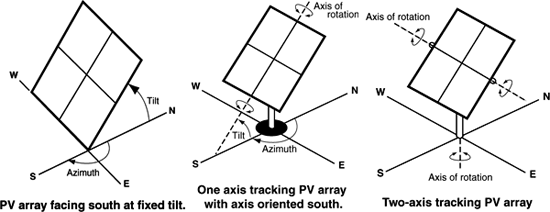
The array type describes whether the PV modules in the array are fixed, or whether they move to track the movement of the sun across the sky with one or two axes of rotation. The default value is for a fixed array, or one with no tracking. Use the following diagrams to choose the appropriate option for your sysrtem:
For systems with fixed arrays, you can choose between an open rack or a roof mount option. The open rack option is appropriate for ground-mounted systems. It assumes that air flows freely around the array, helping to cool the modules and reduce cell operating temperatures. (The array's output increases as the cell temperature decreases at a given incident solar irradiance.) The roof mount option is typical of residential installations where modules are attached to the roof surface with standoffs that provide limited air flow between the module back and roof surface.
For the open rack option, PVWatts® assumes an installed nominal operating temperature (INOCT) of 45 degrees Celsius. For roof mount systems, the INOCT is 50 degrees Celsius, which corresponds roughly to a three or four inch standoff height. See the Technical Reference for details.
One-axis Tracking and Backtracking
For the one-axis tracking option, PVWatts® models the effect of self-shading. Self-shading is a reduction in the array's output caused by shading of neighboring rows of modules at certain times of day and year when the sun is low on the horizon. One-axis tracking with backtracking is a tracking algorithm that rotates the array toward the horizontal during early morning and late evening hours to reduce the effect of self shading.
The self-shading calculations use the advanced parameter Ground Coverage Ratio (GCR) to represent the distance between rows of modules in the array, and assume a rotation limit of ±45 degrees from the horizontal. See the Technical Reference for details.
Shading, Tracking, and Other Losses
PVWatts® does not model self shading for the fixed or two-axis tracking option, tracker losses, or shading by nearby objects. You can adjust the System Losses percentage to account for those losses. See System Losses for details.
Albedo .
Bifacial .
Soiling .